
Empowering Tomorrow’s Creators: The Evolution of Fine Art and Digital Media at Hope Institute of Art and Technologies
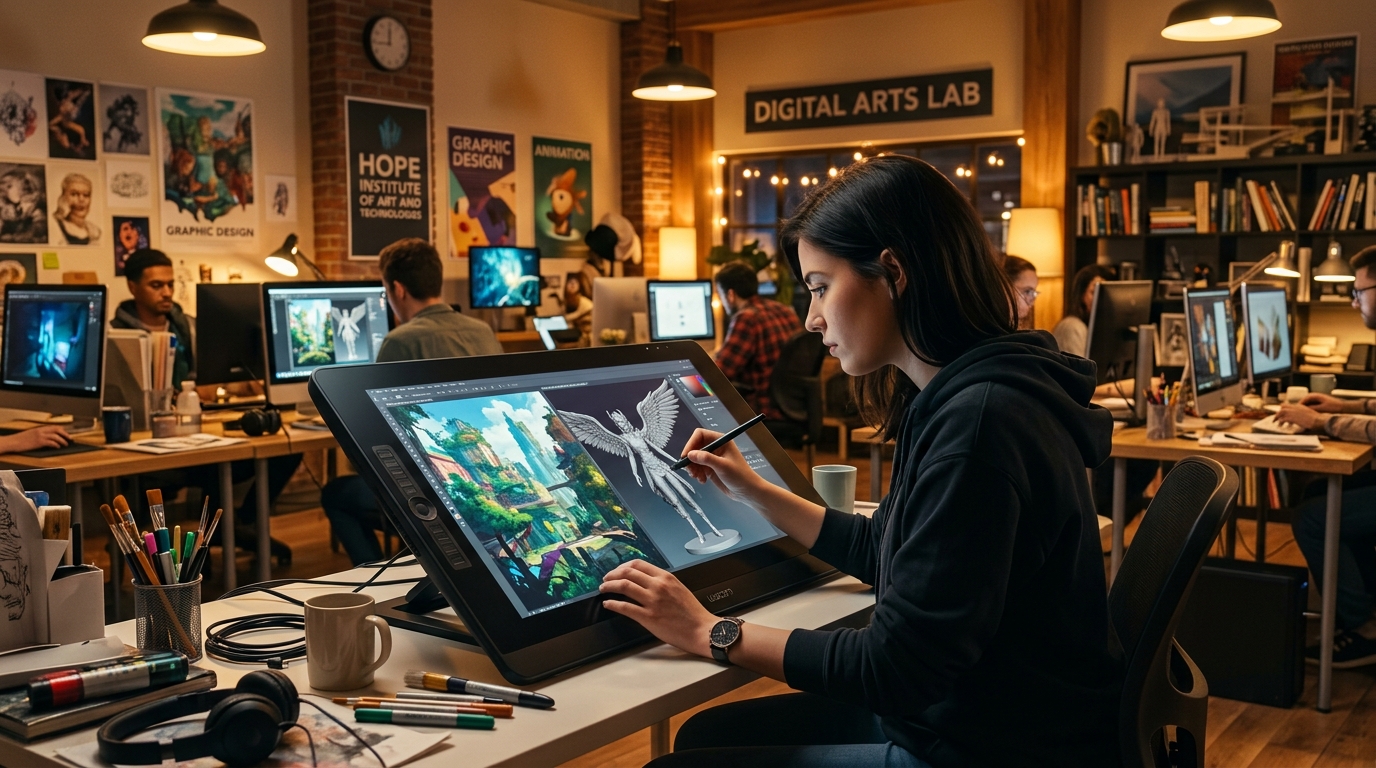
Art and technology are no longer parallel disciplines; they are deeply intertwined forces reshaping how human culture communicates, innovates, and solves complex visual challenges. At Hope Institute of Art and Technologies, our educational philosophy centers on unlocking creative potential by combining classical fine art fundamentals with industry-standard digital tools.
1. The Historical Evolution: From Canvas to Pixels
For centuries, master artists spent years honing their craft using charcoal, oil paint, clay, and physical sculpture. The physical medium demanded meticulous patience, anatomical understanding, and an intuitive grasp of natural lighting. At Hope Institute of Art and Technologies, we firmly believe that digital tools—no matter how advanced or automated—are only as effective as the visual principles guiding the artist's hands.
Every student entering our Fine Arts and Digital Media program begins with structured tactile exercises. Before touching a digital drawing tablet or 3D modeling software, students master hand-drawn gestures, value studies, architectural perspective, and physical sculpting. This rigorous traditional training ensures that when they transition to digital environments like Wacom Cintiq displays, Adobe Creative Cloud, and Autodesk Maya, their visual instincts are grounded in genuine artistic understanding rather than software presets.
2. Key Pillars of Our Interdisciplinary Fine Arts & Media Curriculum
Our program is structured around four comprehensive academic pillars that prepare students for high-level creative careers across the global entertainment and technology sectors:
- Observational Fine Art & Anatomy: Life drawing, spatial awareness, and form analysis to build deep spatial intelligence and muscular anatomy precision.
- Digital Illustration & Concept Art: Character design, environmental concept creation, visual storytelling, and matte painting for entertainment media and publishing.
- 3D Modeling & Digital Sculpting: High-polygon digital sculpting using ZBrush, procedural texturing in Substance 3D Painter, and clean topology retopology for real-time engines.
- Visual Effects (VFX) & Compositing: Motion graphics, node-based compositing in Nuke, green screen extraction, and cinematic lighting setups for film and television.
3. The Shift to Virtual Studios and Real-Time Rendering
The global creative industry has undergone a seismic shift toward real-time rendering and virtual production. Traditional rendering pipelines that used to take days or weeks can now be previewed instantly through engines like Unreal Engine 5 and Unity. At Hope Institute of Art and Technologies, our state-of-the-art computer laboratories allow students to work directly within high-end production environments.
Through hands-on studio projects, students learn how to construct immersive 3D environments, set up dynamic volumetric lighting, and produce real-time cinematic sequences. Industry guest lecturers from animation studios and game development firms regularly review student portfolios, providing real-world feedback that elevates visual quality to commercial standards.
"True innovation happens at the intersection of creative intuition and technological mastery. At Hope Institute, we don't just teach software buttons; we nurture creative visionaries who lead the global digital entertainment industry." — Department Head of Digital Arts, Hope Institute
4. Studio Case Study: Bringing a Concept to Life
To understand the practical depth of our curriculum, consider our flagship second-year project: The Studio Pipeline Challenge. Students are paired in cross-disciplinary teams to take an original intellectual property from concept sketch to a fully realized 3D asset bundle.
The workflow mirrors top feature-film and AAA video game production standards:
- Phase 1 — Concept & Silhouette Research: Generating dozens of exploratory thumbnail sketches, defining shape language, and establishing color scripts.
- Phase 2 — High-Detail Digital Sculpting: Translating 2D artwork into 3D digital clay in ZBrush, detailing skin pores, armor scratches, and fabric folds.
- Phase 3 — Texturing & Shader Engineering: Baking normal maps, roughness maps, and metallic channels in Substance Painter to create realistic light interaction.
- Phase 4 — Lighting & Cinematic Presentation: Importing assets into Unreal Engine 5, configuring Lumen global illumination, and rendering final high-resolution stills and turntable video clips.
5. Bridging Student Ambition with Global Career Paths
One of the distinguishing features of Hope Institute of Art and Technologies is our project-based portfolio studio. We recognize that employers in game design, film production, advertising, and corporate branding look for tangible proof of skill rather than theoretical test scores.
Throughout their academic journey, students build comprehensive digital portfolios hosted on dedicated institute showcase platforms. From conceptualizing an original character to delivering a fully rendered, game-ready asset, every assignment is designed to mirror real studio deliverables. Our graduates have successfully transitioned into high-impact roles including:
- Lead Concept Artists: Creating environmental and character art for international gaming franchises and publishing houses.
- 3D Generalists & Technical Animators: Designing broadcast graphics, commercials, architectural visualizations, and feature film visual effects.
- UI/UX Visual Designers: Crafting high-end user interfaces for mobile applications, augmented reality platforms, and enterprise software.
- Art Directors & Studio Founders: Launching independent design agencies, creative production houses, and game development studios.
6. Advanced Hardware, Software, and Digital Art Infrastructure
At Hope Institute of Art and Technologies, we believe that world-class education requires world-class equipment. Our digital arts facilities feature professional dual-monitor workstations equipped with NVIDIA RTX graphics processors, pressure-sensitive drawing displays, high-resolution 3D scanners, and dedicated render farms. Students gain unrestricted access to industry-standard software suites including Maya, ZBrush, Houdini, Substance Suite, Nuke, DaVinci Resolve, and Adobe Creative Cloud.
7. Faculty Mentorship and Industry Collaboration
Our faculty members are active practitioners who bring decades of industry experience directly into the classroom. From veteran animators who have worked on Hollywood blockbusters to award-winning digital painters and game designers, Hope Institute instructors provide personalized mentorship that accelerates creative growth. Regular masterclasses and portfolio critique sessions ensure that every student's work meets international commercial standards.
8. Frequently Asked Questions (FAQ) for Prospective Digital Arts Students
Do I need prior digital painting experience to enroll?
No. While basic visual interest is recommended, our foundational modules start from core observational drawing and digital software basics, allowing beginners to rapidly build professional competency.
How does Hope Institute assist with industry job placements?
Hope Institute maintains dedicated industry placement partnerships with design studios, animation agencies, and tech firms. We host annual career fairs, portfolio review days, and internship placements that directly connect our graduates with hiring managers.
9. Fostering Community, Mentorship, and Creative Freedom
Education at Hope Institute extends far beyond classroom hours. Our open studio spaces, digital art labs, and annual Art & Tech Exhibition create a vibrant ecosystem where ideas are freely exchanged. Senior students mentor incoming freshmen, while faculty members act as creative directors guiding real-world client projects.
As virtual reality, augmented reality, and generative AI continue to transform creative media, Hope Institute of Art and Technologies remains dedicated to keeping our students at the forefront of digital art. By instilling ethical creative practices, respect for original artistry, and technical fluency, we ensure that our graduates remain indispensable creative leaders in the digital age.
10. How to Begin Your Creative Journey at Hope Institute
Whether your passion lies in classical painting, digital concept art, game design, or interactive media, Hope Institute offers the tools, community, and expert faculty needed to transform your ambition into a thriving career. Visit our campus, explore our portfolio showcase, or contact our admissions counseling team today to discover what makes Hope Institute of Art and Technologies a premier beacon of artistic and technological excellence.
