YouTube Video Editing Services for Faceless Channels: Complete 2026 Guide
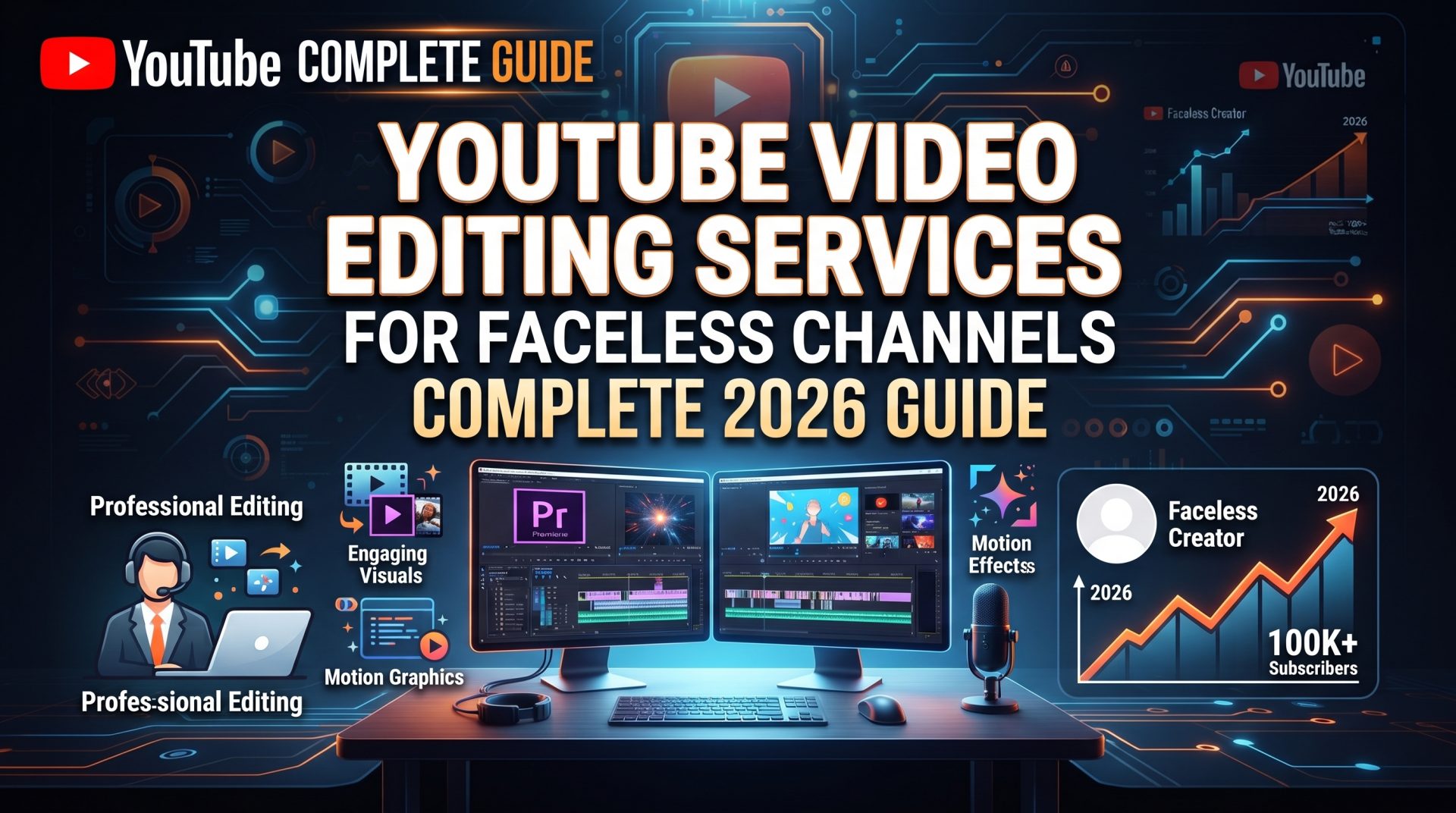
The faceless YouTube channel is 2026's defining creator trend: no camera, no face, no on-screen personality — just script, narration, visuals and a strong idea. The catch is that a single 15-minute documentary-style video can still take ten hours to produce. Editing is where faceless channels either scale or stall. Professional YouTube video editing services for faceless channels solve the bottleneck directly: they turn a loose column of audio and clips into a finished, retention-shaped video on a reliable schedule.
Why Faceless Channels Need Serious Editing
Faceless content lives or dies on visual rhythm and audio quality. With no host charisma to fall back on, the edit is the personality:
- Scenes and b-roll must match the narration beat-for-beat.
- Pacing must sustain retention — the algorithm's lifeblood — across ten-plus minutes.
- Audio must be immersive: clean narration, subtle ambience, properly ducked music.
- Captions and hooks must follow the platform's strongest conventions.
Good editors build these into every delivery, which is precisely what turns a channel from "consistent uploads" into "content people finish."
What a Faceless Editing Service Includes
Narration Assembly
If you supply voice-over, the editor cleans audio, tightens breath gaps and aligns pacing. If you want AI narration, they produce and mix it to sound natural — never robotic.
Visual Matching
Selecting and timing stock footage, archival clips or AI-generated scenes against your script. Visual relevance is a craft — random stock breaks immersion and kills retention.
Motion and Transitions
Subtle zooms, tracking and cuts that keep the frame alive to match the 2026 viewing standard. Overkill distracts; the edit should feel invisible and inevitable.
Captions, Titles and End Screens
Kinetic captions, branded titles and loop-friendly end hooks — the details that push retention ceilings upward.
Editing Rates for Faceless Content (2026, USD)
| Video length | Typical cost per video |
|---|---|
| Short (under 60s) | $20 – $60 |
| Mid (5–10 min) | $60 – $150 |
| Long-form documentary (10–20 min) | $150 – $400 |
| Monthly retainer (4–8 videos) | 15–30% below per-video rates |
Retainers are the practical choice for faceless channels: a fixed slot each week, consistent style, and predictable cost. A dedicated video editing and production service gives you that consistency without stitching together freelancers every month.
Editing vs. Production: Where AI Fits
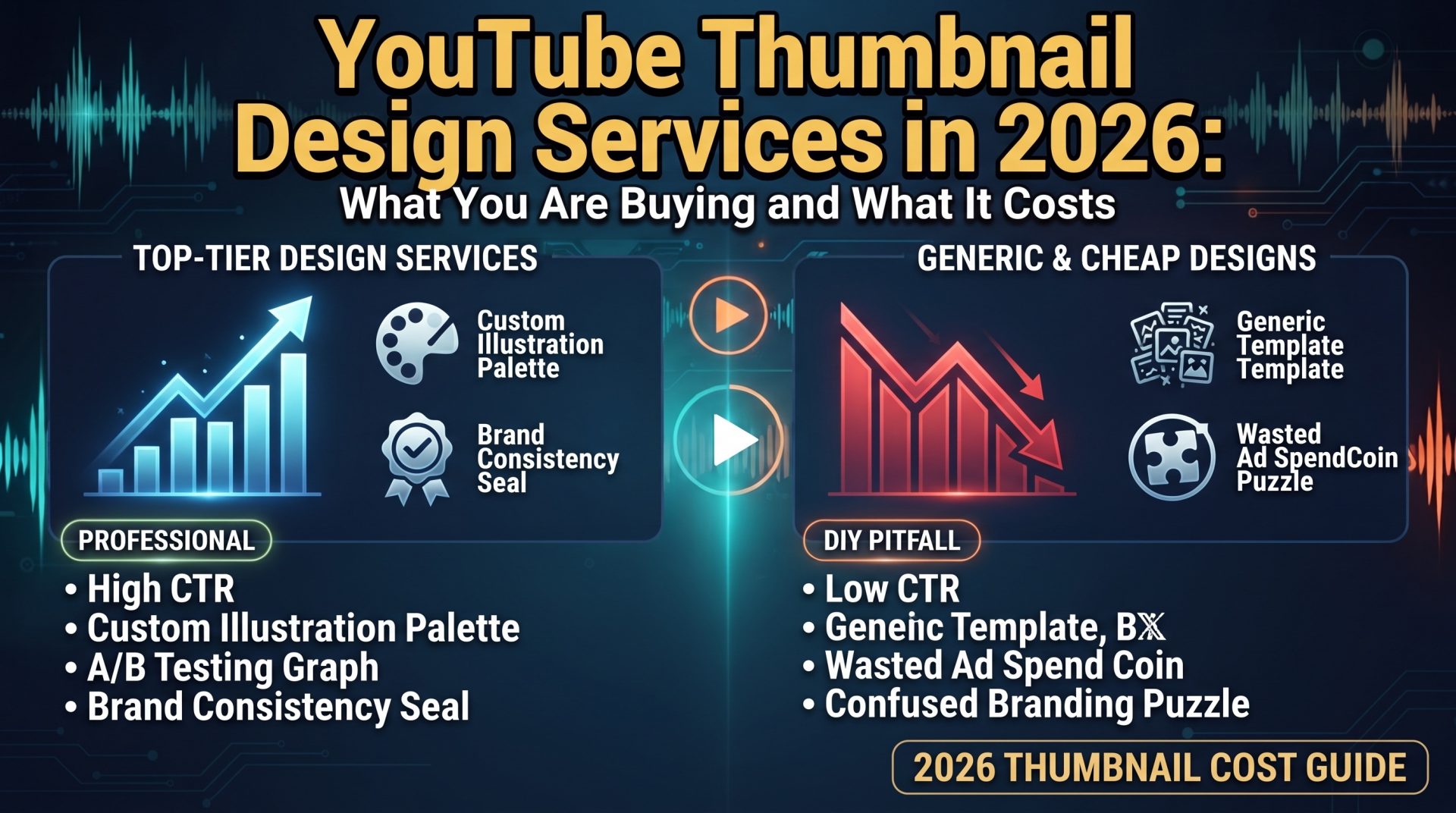
2026's channel stacks often blend AI tools — script generation, AI voiceover, even generative scenes — with human editing. The winning pattern is: AI for speed, humans for judgement. Editors take AI's raw output and add what tools cannot: narrative flow, brand consistency and retention craft. When you also outsource the thumbnail, the package becomes close to turnkey. Thumbnail design is the other half of the click, and bundling it keeps your upload a single, finished asset.
A Simple Production System for Faceless Channels
Consistency beats brilliance for faceless channels, and consistency only happens when there is a repeatable system behind the uploads. The common rhythm is: research a proven topic, write a tight script, record or generate the voiceover, edit the visuals with motion graphics and captions, design a thumbnail, and schedule. Each step can be delegated, which is exactly why the faceless format suits a small team or a service provider — the editing partner takes the raw material and returns a finished, platform-ready video with a matching thumbnail and title options.
Where channels stall is not editing skill but pipeline. Ideas are not turned into scripts, or scripts sit unrecorded, or finished videos wait days to be scheduled because no one owns the calendar. Agree on a weekly target — even one strong video per week is enough when it is delivered every single week — and put the production calendar on a shared document so the edit queue is visible to everyone. Set a style reference early: your preferred pacing, color grade, caption style and intro template. When revisions are bounded and the template is fixed, per-video turnaround shrinks dramatically and quality climbs, because the editor stops reinventing the format and starts refining it. That single change — a system instead of one-off requests — is what turns a faceless channel from a hobby into an asset.
Before committing to a partner, define your metrics on this format: retention in the first thirty seconds, subscribers gained per video, and the click-through of the thumbnail. A strong editor thinks in these terms, not just in fancy transitions. That is why a portfolio is never the whole story — raw editing skill is common, but someone who understands pacing, hooks and the delicate balance of information density is what makes a faceless channel feel deliberate rather than generic. When you interview partners, ask how they would edit your weakest video, and listen for whether they talk about storytelling or only about effects. The answer predicts your next twelve months of content quality.
How to Pick an Editing Partner for Your Channel
- Watch their finished videos in a related niche — judge pacing and retention, not the showreel highlights.
- Confirm the style. Documentary? Commentary? Sleep stories? Match the editor's craft to your format.
- Test with three videos before a long commit. Consistency reveals itself over a month.
- Raise turnover numbers — turnaround time and a defined revision count.
- Ask how they manage AI voice. A partner should be able to make it sound human.
Frequently Asked Questions
Do I need to script before hiring an editor?
Yes — a script is the blueprints. Editors work from your narration and brief; most also offer light script-tightening as part of production.
Can editors use AI visuals and voiceover?
Absolutely. In 2026 the best teams combine AI assets with human editing judgement — the difference is that they curate and polish, not just paste.
How fast is a typical turnaround?
24–72 hours for shorts, 3–5 days for mid-length, up to a week for documentary-style — depending on footage volume and style consistency.
Final Thoughts: The Channel That Outlasts the Trend
Faceless channels succeed with systems, and editing is the biggest subsystem of all. When editing, thumbnails and a release schedule all run like clockwork, the channel compounds — viewers subscribe faster, the algorithm trusts you more, and the operation works without burnout. Send us your channel and a sample brief — we will show you what finished episodes could look like and what they would cost to produce each week.