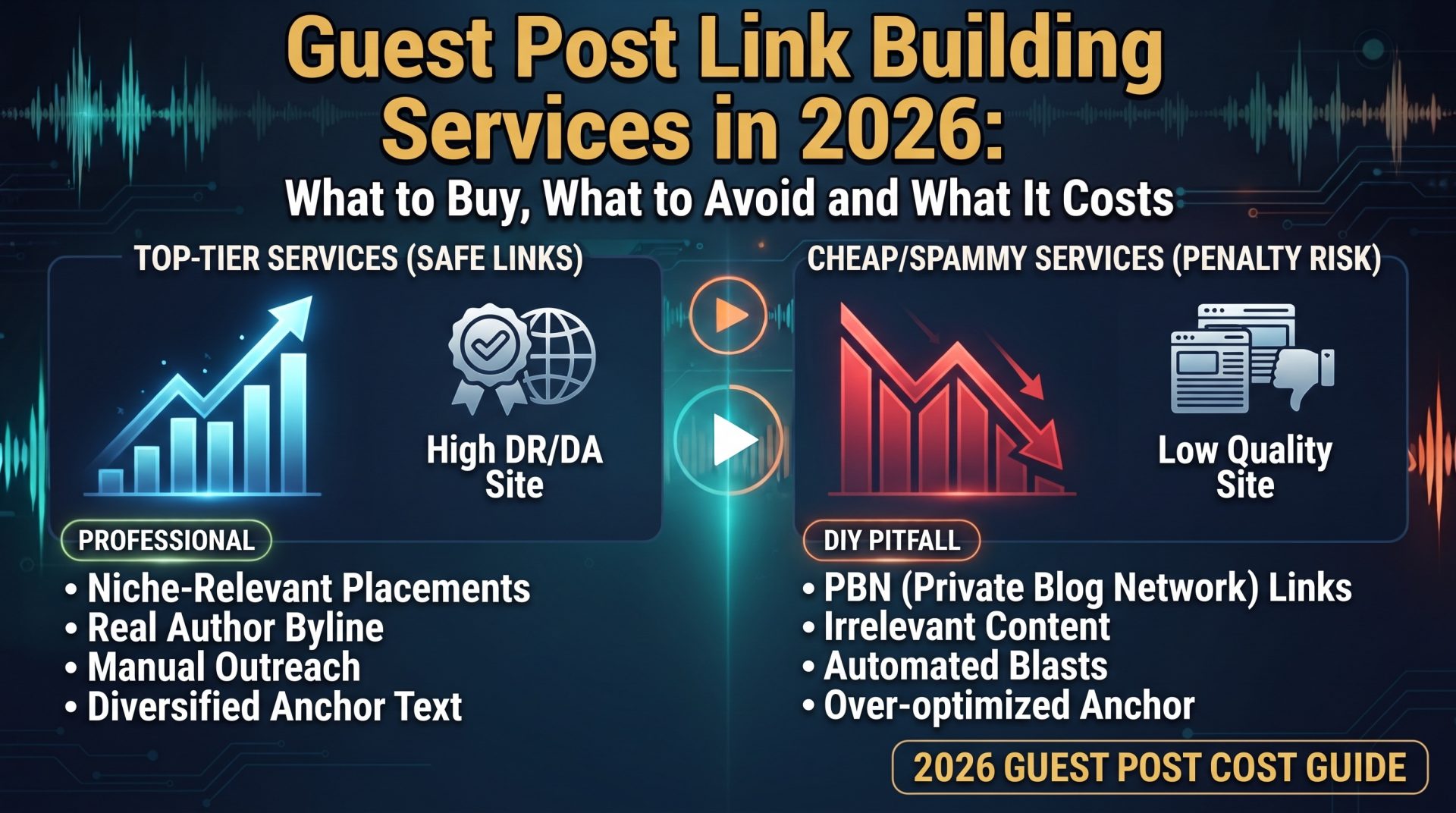
Backlinks remain one of the strongest ranking signals in search, and guest posting remains the most defensible way to earn them. But 2026 is not 2018. Spam crackdowns killed the "5,000 links for $99" era, AI content farms flooded the market with link pages that no human reads, and search engines got much better at ignoring — or punishing — both. Buying links correctly now means buying real editorial placements on real, relevant websites, at a price that reflects actual work. This guide explains how legitimate guest post services operate, what they cost, and the exact questions that separate a safe investment from a penalty waiting to happen.
What Changed: Why "Buying Backlinks" Now Backfires
The cheap bulk-link era ended because the search engines learned to spot the pattern: thousands of identical anchor-heavy posts on networks of junk domains, all pointing at the same money site. Today, one link from a relevant, real, visited website is worth more than a hundred from ghost domains — and a cluster of low-quality links is not merely useless, it is an active risk. The penalty is rarely instant and dramatic; it is more often a slow erosion, a mysterious dip as the site's quality score quietly re-evaluates. In this environment, the goal of link building is not "more" — it is "legitimately placed, genuinely read".
How Legitimate Guest Post Services Work in 2026
Outreach and placement
A real service starts with identifying domains where your content genuinely belongs — publications in your niche, reputable blogs with an audience, sites whose readers match your customers. It then pitches the editor a real article. Ideally the placement is marked as a guest contribution, with author credits intact and natural internal links to the host's own content. This is digital PR wearing an SEO hat.
Content you can stand behind
The post itself must be original, useful and something you would publish on your own site. If the post would embarrass you on your homepage, it will not help you in search. Good services draft to editorial standard, pass plagiarism and AI-pattern checks, and give you the right to edit before publication.
Relevance beats quantity
Thematically relevant links signal to search engines that your site belongs in a conversation. A plumbing company link on a travel blog is wasted money; the same link on a home-services publication is a currency. The best services build a small, relevant handful per month rather than dozens of stale listicles.
What It Costs in 2026
| Service | Typical cost | Notes |
|---|---|---|
| DIY outreach (your time) | Hours per placement | Slowest, most controllable |
| Single quality placement | $150 – $800 | Relevant blog, real domain authority |
| Monthly link building programme | $1,000 – $5,000 | 3–10 placements, vetted sites |
| Full digital PR campaign | $5,000 – $20,000 | Press, data studies, editorial links |
Cheap "guest posts for $20" now almost always mean low-quality inventory. The proper SEO investment is priced per placement of genuine value, and the per-placement model keeps the incentives aligned: you pay for reach, not for volume.
Preserving Your Authority While Building It
Audit before you buy
Ask for the exact URL list before paying. Check the domains yourself — traffic, topic, whether the site actually publishes guests, whether its home page reads like a person. A service that refuses to share URLs is selling you inventory it does not want examined.
Vary your anchors
Branded names, ranks, URLs and a few natural phrases beat a wall of identical keywords. Anchor over-optimisation is one of the oldest penalty flags there is, and it still works that way.
Balance your link profile
Guest posts are one ingredient. Directory presence, mentions, citations, reviews and genuinely earned editorial links together build a profile that looks — and is — organic. A healthy link profile is boring, which is precisely its strength.
Measuring Return: Traffic, Not Just Rankings
The best signal that a placement worked is not the ranking chart; it is referral traffic. A guest post on a site your audience reads will deliver visitors, enquiries and brand searches that appear in your analytics as clicks with a real referrer. If a "high domain authority" placement produces zero referral traffic and never moves a needle, it was probably purchased for a metric that the market has already learned to game. Judge your link building by what lands in your own analytics, and you will naturally stop buying the kind of links you can never see.
Building Links In-House vs. Outsourcing
In-house outreach gives you total control and ownership of relationships, at the cost of significant time and the skill of cold-pitching editors. Outsourcing buys speed and inventory you could not easily reach, at the cost of transparency and trust — unless the service shares its process and its URLs openly. Many businesses blend: in-house for the flagship placements they want to write themselves, an external programme for the steady background signal. Whichever route you choose, keep the discipline of relevance, editorial quality and honest reporting — those three habits are what separate a link profile from a lawsuit waiting to happen.
Frequently Asked Questions
Are guest posts still worth it in 2026?
Yes — they remain the most justifiable way to earn links at scale, as long as they are real placements on relevant sites with content people actually read.
How many guest posts should I buy per month?
Three to five relevant placements beat thirty junky ones. Build steadily over months and measure referral traffic, not just domain authority.
What is a red flag in a link service pitch?
Guaranteed "domain authority 50+" on sites you cannot preview, unbelievably low prices, and content you are not allowed to read before publishing.
And keep a steady cadence rather than a frantic push. Search engines value history: links earned gradually across months, alongside a genuinely useful site, look like success; links dumped in a fortnight look like an attempt. If your industry is seasonal, let your placements follow your content calendar — publishing relevant guest posts when your own site's content is strongest produces a coherent, defensible profile. Log every placement, its URL and its date, because one day you will want to know exactly what points at you. And above all, keep the link profile boring and honest: real sites, real content, real relevance. The 2026 winners are not the loudest link buyers; they are the patient ones who publish value where their customers already read.
Links are votes, and in 2026 the ballot is audited. Buy placements that add genuine value to real readers, and the votes will keep counting in your favour.