
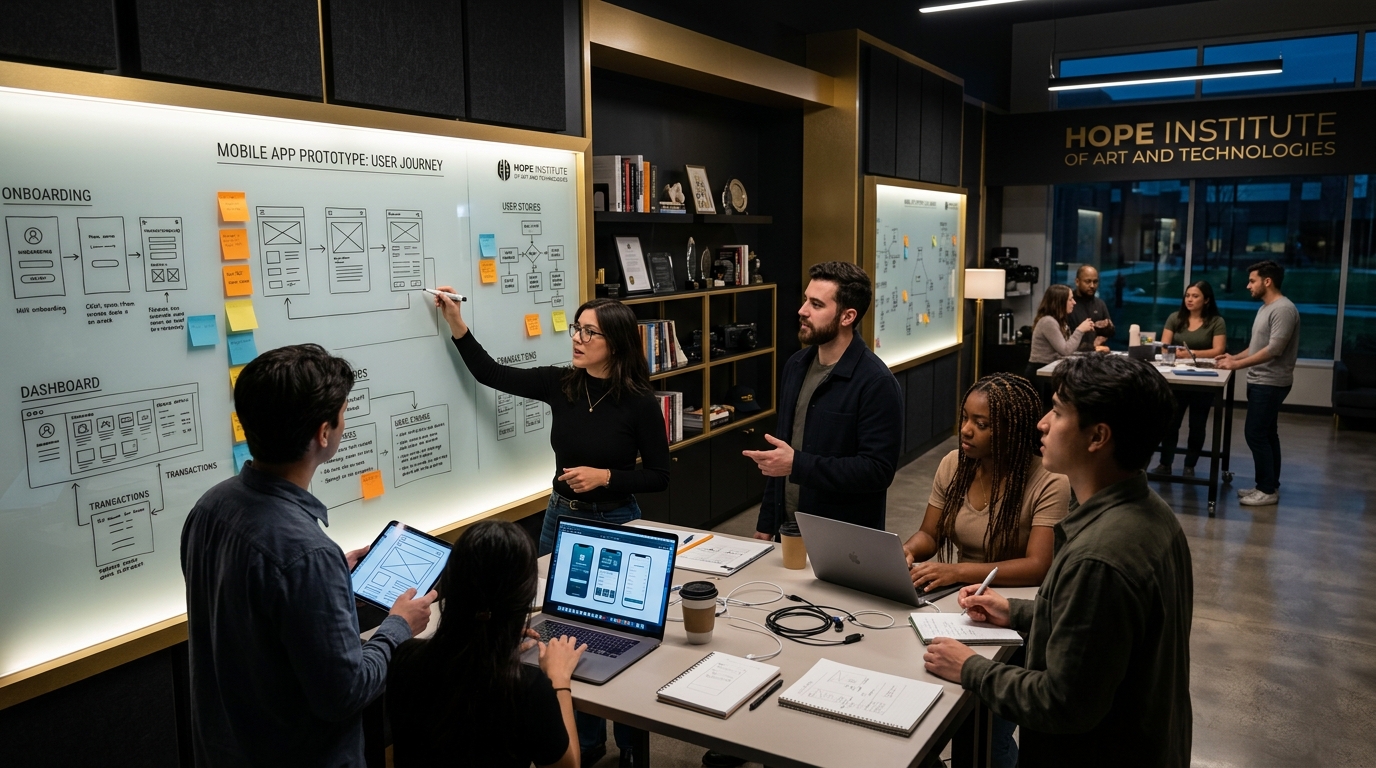
Great digital products succeed not by coincidence, but by meticulous design, deep empathetic user research, and seamless interface architecture. At Hope Institute of Art and Technologies, our UI/UX and Digital Product Architecture program equips students with the strategic mindset and hands-on toolset needed to shape human-computer interactions for modern web and mobile platforms.
1. The Strategic Role of UX Design in the Digital Economy
User experience (UX) design has matured from a decorative afterthought into a primary business driver. Companies worldwide recognize that intuitive navigation, lightning-fast interaction response, accessible visual design, and reduced cognitive friction directly determine customer retention, brand loyalty, and recurring revenue growth.
At Hope Institute of Art and Technologies, we train product designers to think like product strategists. Students do not simply create attractive screens; they conduct deep user interviews, map quantitative behavioral analytics, formulate user personas, build wireframe prototypes, and validate design decisions through empirical user testing and iterative feedback loops.
2. Core Pillars of the Hope Institute UI/UX Curriculum
Pillar A: User Research & Usability Engineering
Every successful digital product begins with a thorough understanding of the end user. Hope Institute students learn qualitative and quantitative research methodologies, including field studies, survey synthesis, card sorting exercises, and competitive benchmarking. By understanding user pain points, cognitive patterns, and business goals, designers form clear hypotheses before producing visual assets.
Pillar B: Information Architecture & Interaction Design
A visually stunning design is useless if users cannot navigate it effortlessly. Our courses teach systematic Information Architecture (IA). Students construct site maps, user task flows, wireframes, and interactive low-fidelity prototypes using Figma, Penpot, and Adobe XD. They learn how to organize information hierarchically to guide users toward their goals with minimal effort.
Pillar C: Design Systems & Component Architecture
Modern software organizations rely on reusable Design Systems to maintain visual consistency and speed up engineering workflows. At Hope Institute of Art and Technologies, students build comprehensive component libraries complete with design tokens, color palettes, typography scales, spacing units, interactive hover states, accessibility focus rings, and dark mode variants.
"Design is not just what it looks like and feels like. Design is how it works, how it scales, and how it empowers human beings to accomplish meaningful tasks seamlessly." — UI/UX Studio Director, Hope Institute
3. Deep Dive: Cognitive Psychology and Behavioral UX Design
Interface design is fundamentally applied cognitive psychology. At Hope Institute, our advanced product design modules explore key psychological principles governing how human eyes scan screens and process information:
- Fitts’s Law: Structuring touch targets and call-to-action buttons with optimal size and proximity for effortless user interaction across touchscreens and desktop pointers.
- Hick’s Law: Minimizing choice complexity on checkout pages and registration forms to reduce decision fatigue and boost conversion rates.
- Gestalt Principles of Visual Perception: Utilizing proximity, similarity, continuity, and enclosure to group related UI elements intuitively.
- Miller’s Law & Chunking: Breaking long forms and complex financial data dashboards into manageable visual chunks to prevent mental overload.
4. Bridging Design with Software Engineering
One of the unique advantages of studying at Hope Institute of Art and Technologies is our interdisciplinary studio model. UX students collaborate directly with software engineering students during capstone projects. Designers learn how their Figma components translate into HTML/CSS code, Flexbox layouts, and React/Vue components.
This hands-on collaboration eliminates the traditional friction between design and developer handoffs. Hope Institute graduates understand technical constraints, performance budgets, responsive grid behaviors, and front-end animation libraries—making them invaluable assets to modern engineering teams.
5. Case Study: Redesigning an Enterprise Healthcare Portal
In a recent third-year studio challenge, Hope Institute UI/UX students were tasked with redesigning a complex healthcare portal used by doctors and patients. Students identified critical UX bottlenecks in appointment scheduling, simplified patient health history navigation, and redesigned medical telemetry graphs for high-contrast legibility.
Usability testing of the student-designed prototype demonstrated a 42% reduction in task completion time and a 95% satisfaction rating from test participants—proving the tangible power of Hope Institute’s human-centered design methodology.
6. Micro-Interactions, Animation, and Motion Design
Motion design adds personality, context, and immediate tactile feedback to modern applications. At Hope Institute, students learn how to design subtle micro-interactions—such as loading skeletons, button state morphing, tab transitions, and animated pull-to-refresh gestures. Using Figma Smart Animate, Lottie, and CSS Keyframes, designers learn to use motion purposefully without degrading UI performance.
7. Quantitative UX Analytics: Heatmaps, A/B Testing, and Conversion Rates
Strategic product design relies on data, not subjective opinions. Students at Hope Institute learn how to set up user analytics telemetry using tools like Hotjar, Google Analytics, and Mixpanel. They analyze click heatmaps, user scroll depth, and drop-off funnels, conducting data-backed A/B split tests to continually optimize user journeys.
8. Accessibility Standards (WCAG 2.2) and Inclusive Product Design
Designing for inclusivity is an essential ethical and technical standard at Hope Institute. Students learn how to implement WCAG 2.2 AA accessibility standards, ensuring high contrast color ratios, screen reader compatibility, keyboard navigation focus rings, and readable font sizing across all digital interfaces.
9. Building a Standout UI/UX Portfolio
A successful design career relies on a compelling portfolio that highlights problem-solving rationale rather than just static pixel shots. At Hope Institute, students document their entire design process—from raw whiteboard sketches and user journey maps to interactive Figma prototypes and usability testing metrics. This comprehensive documentation gives our graduates a decisive advantage during job interviews.
10. Career Progression and Industry Outcomes
The demand for skilled UI/UX designers and product architects continues to expand globally. Alumni from Hope Institute have secured leadership and specialist roles across diverse global industries:
- Product Designers (SaaS & Fintech): Designing complex analytical dashboards, data visualizations, and secure banking workflows.
- UX Researchers: Leading user interview studies and usability labs for international tech companies and research institutes.
- Design Systems Architects: Maintaining enterprise design libraries and UI guidelines for multi-platform web and mobile products.
- Creative Tech Consultants: Helping startups redesign legacy applications for improved conversion, accessibility, and user retention.
11. Transform Your Passion for Design into a Thriving Tech Career
If you possess a passion for visual aesthetics, human psychology, and cutting-edge digital technology, the UI/UX program at Hope Institute of Art and Technologies provides the perfect environment to cultivate your talent. Join a community of forward-thinking creators and start building digital experiences that change how people live and work.