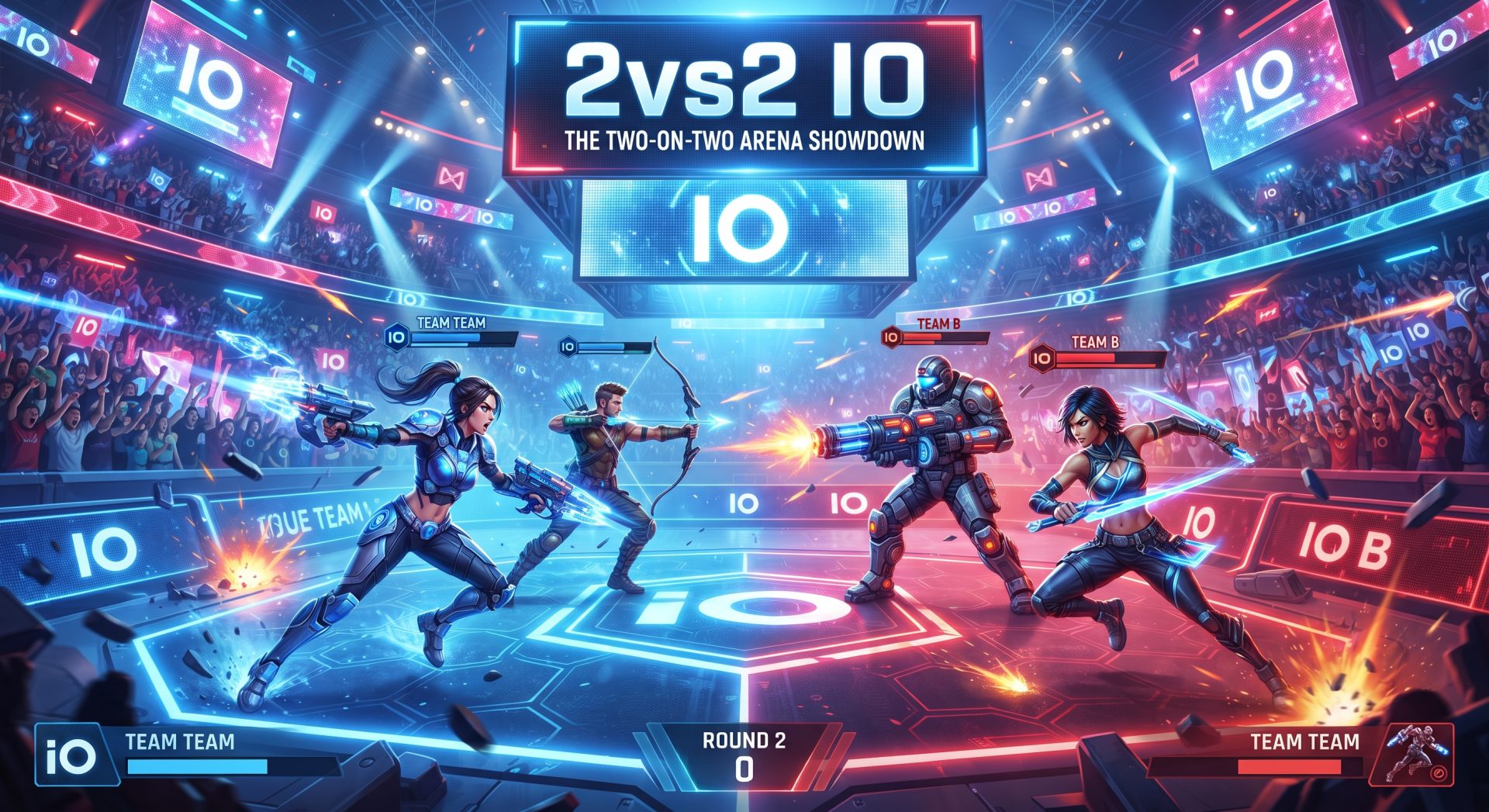
Some browser games wave a big banner and announce themselves, while others sneak up on you in a small arena where every second matters. 2vs2 io belongs firmly in the second camp. It is a compact, fast-paced arena dueler built around two-versus-two fights, where your partner is the difference between a quick elimination and a long winning streak. Each match is short, each battle is physical, and the entire fight unfolds inside a space small enough that there is nowhere to hide.
At its heart, 2vs2 io is about controlled aggression. Forget sprawling maps and long sniper angles. This game squeezes the fight into a tight box, which means teams meet constantly from the very first seconds. There is no laning phase and no farming stage. Both sides are thrown together immediately, and the pair that coordinates better almost always leaves the arena with the victory.
How the two-versus-two format changes everything
The big difference from solo arena games is the teammate. In 2vs2 io, your partner is both a resource and a responsibility. A good partner draws fire, finishes kills, and covers your flanks, but a bad partner splits the healing, feeds the enemy, and turns every fight into a losing miracle. The developers built the whole balance of the game around this pairing, which means the meta is as much about cooperation as it is about aim.
Because the arena is small, position is always contested. The center of the map is constantly in dispute, the power-up spawns are fought over within seconds of appearing, and running away usually just leads you into another enemy ambush. The map pushes you toward confrontation, and the teams that embrace that pressure tend to climb much faster than the groups that try to play passively at the edges.
Roles inside the pair
Most successful duos in 2vs2 io drift toward a light role split. One player takes the aggressive role, pushing forward, bullying the enemy lane, and forcing engagements. The other plays the support role, staying slightly behind, keeping pressure off the lead, and staying alive to grab resurrections and clean up weakened targets. The split does not have to be rigid, but knowing who commits first prevents wasted fights.
Movement, aim, and the feel of a duel
Movement in 2vs2 io is quick and responsive, with a smooth feel that rewards strafing and sudden direction changes. Shots are precise but dodgeable, and skilful players learn to move in irregular patterns to defeat enemy prediction. Because the arena is so small, dodging is most effective up close, where tight turns confuse opponents who are leading their shots for longer paths.
Weapon variety keeps fights fresh. Some weapons fire in tight spreads that punish clustered enemies, which is a natural fit for a format where both opponents often stand close together. Others fire fast single shots that reward tracking aim, while a few weapons excel at area denial and map control. Switching loadouts between rounds is half the strategy, and ignoring the match-up is a fast way to lose.
Reading the opponent duo
One of the fastest ways to improve is learning to read the enemy pair. Observe which opponent leads the aggression and which one hangs back. Target the support first if the carry rapidly snowballs, or dismantle the aggressive player early if the support is weak alone. In a two-versus-two format, splitting the pair by forcing one enemy out of position is one of the strongest plays available.
Team coordination beyond just fighting
Good teams in 2vs2 io coordinate more than their attacks. They share positioning so that both players can retreat to one another when a fight turns bad. They time their power-up grabs so that one player delays the enemy while the other secures the spawn. They use simple callouts for focus fire, and they deliberately alternate who takes the lead in each round to keep the enemy guessing.
Switching who is the target matters too. If the enemy always focuses the same player, that player goes down consistently and the match snowballs. By rotating aggression, a pair keeps both members healthy and makes the opposing team work harder for every single elimination. This constant role rotation is one of the subtlest and most effective tricks in the game.
The value of pausing before the push
Patience is underrated in a fast arena. Many fights are lost because one player pushes a moment too early. A short pause to reposition, grab a health pack, and wait for a power-up can turn a doomed push into a winning one. The best duos in 2vs2 io know when to press and when to reset, and that rhythm is what separates a flurry of losses from a smooth win streak.
Learning curve and getting to your first win streaks
New players sometimes feel that the game is too chaotic, but the chaos settles quickly. The first few rounds teach you the map layout, the spawn points, and the weapon spread. After that, fights start to feel readable, and after a handful of matches you will start spotting enemy patterns before they happen. Most players reach a comfortable skill level within a single session.
Win streaks build on momentum. Once the duo finds a rhythm, matches flow faster, weapons feel snappier, and even close calls go your way. Look after your partner’s health, share the glory of the power-ups, and keep the communication simple. Teams that talk in short, clear phrases consistently outplay silent random duos who just flail their way through matches without a plan.
Choosing a partner and playing with randoms
- Prefer partners who rotate their movement and adjust to your position instead of playing entirely alone.
- Decide before the match whether you are the aggressive player or the support, then stick to that decision.
- Share power-ups by letting the neediest player grab the spawn rather than racing your partner for every pickup.
- Focus fire the same enemy together, since a fast kill instantly turns a two-versus-two into a one-versus-two.
- Reset the fight when both teammates are low rather than trying to win desperate trades into the enemy.
- Treat the smaller arena as an advantage, using walls and corners to break enemy line of sight.
Playing with a regular partner is the fastest way to climb, but solo play with random pairings still teaches the fundamentals. The key is adapting to a stranger’s style quickly instead of clinging to your own habits. Flexible players win far more duo matches than rigid ones.
Why the small arena actually helps you improve
The compact map is a training tool disguised as a limit. Because the space is small, fights happen constantly, which means you get more reps per minute than in any large map game. Movement mistakes are punished immediately, aim leading is learned through constant contact, and reading enemy intent improves because every threat is always nearby.
That density of action is also why the game feels so energizing. There is no walking simulator phase in this game; the engagement starts at zero seconds and keeps running until the last elimination. The intensity is relentless, but it is also fair, because both teams operate under the exact same pressure in the exact same space.
Frequently asked questions
Do I need a friend to play 2vs2 io well?
Not at all. While a regular partner makes coordination easier, the matchmaking pairs you with other solo players just as often. Many of the fundamentals, like positioning, dodging, and focus fire, improve even during random pairings. Play enough matches and you will naturally learn to sync with strangers within the first few seconds of a round.
Is 2vs2 io easy to pick up for beginners?
Yes. The controls are simple enough to learn in the first minute, and the small arena removes the confusion of large maps. The first few matches will feel frantic, but the constant action means you improve fast. Within one session, most beginners go from flailing to landing consistent shots and occasionally winning rounds.
How long does a typical match in 2vs2 io last?
Most matches finish in a few minutes, thanks to the small arena and fast eliminations. There is no waiting around between rounds, and the flow from one fight to the next stays quick. That short length makes it perfect for a quick break, and the addictive match-to-match rhythm is exactly what keeps players coming back.
What is the best way to coordinate with a random teammate?
Use short, clear signals and observe their behavior in the first round. If they push hard, play support and cover them. If they play defensively, take the lead and generate pressure. Mirroring your partner’s tendencies is far more effective than trying to force them to match your own style.
Can I improve my aim specifically for duels in 2vs2 io?
Yes, and the most effective drill is simply to focus on leading shots at moving targets during warm-up rounds. Because the arena is small, opponents rarely move in straight lines, so practice tracking with constant small corrections. Over time, your hand learns to follow the strafing patterns that every good duelist uses.